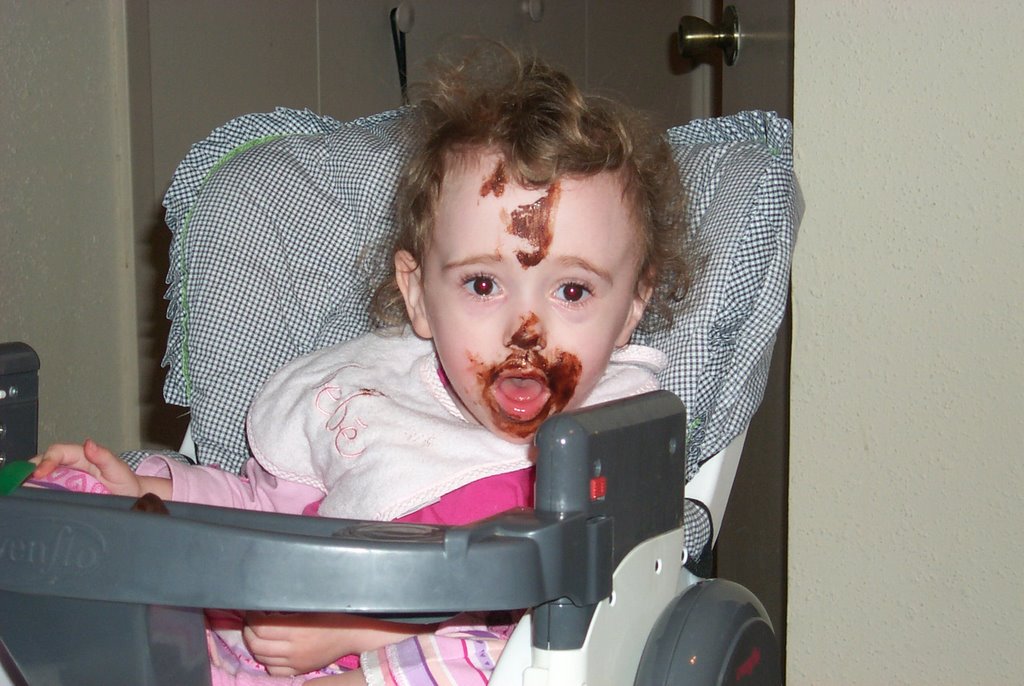
Friday, December 07, 2012

I haven't posted here in 2012, which is rapidly coming to an end, so I'm doing so now mostly to keep the account from going dormant.  Working full time prevents me from dedicating as much mental energy to mind-fucking (excuse the language, but it's MY blog) what I did wrong in the past and will surely do wrong in the future. 

The girl is wonderful and joyous.  First grade last year was miserable, but so far second grade is going great.  She's in a class that is a better environment for her, and we've started her on some medication that seems to be helping with her impulsiveness and inattention.  She loves Angry Birds, My Little Pony, and watching YouTube videos of people putting together Lego projects.  She could do a search on YouTube before she could consistently write her name, if you want to know the truth.

We had a trauma when we learned her developmental pediatrician had moved out of state, and the hospital where she had worked had not found a replacement.  The other hospitals in town have, literally, months-long waiting lists to see developmental specialists, and we discovered this at a time when Susan was having daily crisis-level behavioral meltdowns.  The insurance company referred me to a clinic 3 hours away as the nearest one taking new patients.  Total nightmare. 

I put out a call for help on the special needs parents' listserv for our state, and fortunately got a referral there to a private clinic in town.  The child psychiatrist there was able to see her within a few weeks.  They don't take insurance, which is why they don't have a waiting list like everybody else, so we have to pay out of pocket and apply for reimbursement from the insurance company.  We are very lucky that we have the means to float this kind of expense.  It's an example of how much the current health care system is failing that necessary care for children is rationed according to parents' ability to pay.

Interestingly, the new doctor doesn't agree with the autism diagnosis.  He says she's PDD-NOS (pervasive developmental disorder - not otherwise specified), which is a fancy way of saying we don't really know anything.  It doesn't actually matter, we use the word "autism" describe a lot of behaviors nobody really understands because it's a convenient and descriptive enough to be useful. 

Topic change here - I'm not bothering with transitions.

She is very good at the decoding aspect of reading - recognizing the words that letters represent - but weaker in reading comprehension.  I think some of that is the way comprehension is assessed. Typically the reader is asked to make inferences from the material, and inference is not something most autistic kids do well.  Example:

Read the following passage: "Ann was excited about her party that afternoon.  She couldn't wait to blow out the candles and open her presents."

Why was Ann excited?
A. Because it was her birthday
B. Because it was morning
C. Because she was 10 years old
D. Because lit candles are on fire.
Susan would have no trouble reading the words of the sentence, or telling you that Ann was excited, that Ann was having a party that afternoon, and that Ann liked to blow out candles and open presents.  She understands the literal meaning of what she reads.  She would have a hard time with the question though, because it requires making the inference that the party is for Ann's birthday.  Susan would probably pick D  as the correct answer, because it is the only option that states something identifies as fact.

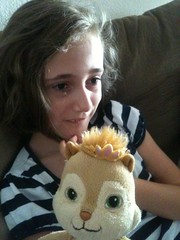
Here she is with her favorite toy Theodore the chipmunk, who was tricked out with a princess crown for her birthday.

Friday, June 24, 2011

New reports on autism and genetic mutations

So, this new study just came out, and it fits dead-on with our experience.

Autism linked to hundreds of spontaneous genetic mutations

Quote from the article:
In 2007, Michael Wigler, a geneticist at Cold Spring Harbor Laboratory in New York, and his colleagues showed that spontaneous mutations — those that arise for the first time in an individual, rather than being inherited — are important in about half of all cases of autism4 (see New mutations implicated in half of autism cases). A follow-up study5 in 2010, of 996 autistic individuals, found that people with autism carry a heavy load of rare duplications or deletions in regions of the genome that contain genes.

Of course, this doesn't answer the big questions, like why are so many more kids getting autism now than there used to be?  And, if there's a link with genetic mutations, what causes those mutations?  I'd sure love to know what happened during my pregnancy that cause a group of cells to break off and do their own thing.

Sunday, January 10, 2010

Genetics for liberal arts majors

edit - My apologies for not previously citing my source for the graphics used in this post.  Thanks to Steven M. Carr of Memorial University of Newfoundland, Canada for the remarkable work.  The image can be seen at http://www.mun.ca/biology/scarr/FISH_chromosome_painting.html.  Here is the copyright info from that page: "Text & image © 2008 by Steven M. Carr, after original by Genetix, with permission"

Here's my nutshell explanation of genetics for anyone who doesn't already know more than I do and is interested in Susan's medical issues, or in bizarre conditions in general. Keep in mind I'm not a science/medicine person by nature so it's all filtered through my liberal-arts mind.

We met with Dr. Dimitri, the geneticist, right after New Year's to talk about the results of some blood tests we ran on Susan in search of more information about the chromosomal abnormality that was diagnosed when she was an infant (Partial Trisomy 9 Mosaic). But alas, instead of learning more, now we know less: the blood test found no abnormal cells.

As you probably know, human DNA is passed from parent to child via chromosomes. A person has 23 pairs of chromosomes, which typically come in pairs: one copy of each chromosome is carried from each parent. When you have a blood test to test for genetic conditions, they extract chromosomes from blood cells, inject them with dye, and look at them under a microscope. They come out looking like this - a bunch of squiggly little lines:


Then the person running the test sorts all the squiggly lines into pairs from largest to smallest, and they come out looking like this:


And there you have your basic human chromosomal array. If the guy sorting them out finds an odd number of lines, that means there's something wrong. The degree to which something is wrong depends on which chromosome shows up an odd number of times. Since they all look a little different under the microscope, the test can show if you've got a third copy of one chromosome, a single copy of another, or some other weird variation. We fall into the weird variation category.

Just to clarify the vocabulary: if a person's cells have three copies of a single chromosome, instead of the usual two, that condition is called TRISOMY of that chromosome. Down Syndrome, the most common form of trisomy, occurs when somebody has three copies of chromosome 21. You can see from the array that 21 is the second-to-smallest of the chromosomes. The fact that the amount of genetic material that repeats is relatively small makes trisomy 21 a condition that causes some developmental and health issues, but doesn't otherwise disrupt the body's ability to function. When the bigger chromosomes start repeating, very bad things happen.

Now if the trisomy - the appearance of the extra chromosome - only occurs in some of the cells in a person's body, then the condition is called a MOSAIC trisomy. If a person has a mosaic condition, the trisomy could appear in any number between 0% and 99.9% of the body's cells. Generally, the higher percentage of trisomy cells a person has, the more severe the symptoms of trisomy are, but the percentage of affected cells is not necessarily consistent throughout the body. A person could have 100% of his skin cells carry trisomy 21, but still have 0% of his brain cells with trisomy. In that case, that person would have mosaic Down Syndrome, but might not show any symptoms at all. (That's not exactly true, since down syndrome effects other systems besides the brain, but it's just a metaphor.)

Separate from mosaicism, another variation on trisomy is a PARTIAL trisomy. That means that instead of having a full extra chromosome, you just have an extra piece of a chromosome. In Susan's case, she has an extra piece of chromosome 9. So while most people have two copies of chromosome 9, and someone with regular trisomy would have three copies of chromosome 9, Susan has something like 2.25 chromosome 9s in her cells. Like with mosaicism, the severity of symptoms of partial trisomy increase with the amount of extra genetic material that is present in the body.  Complete trisomy 9 is one of the conditions labelled "not compatible with life," so if she had a full copy of 9 in all of her cells, Susan wouldn't be alive, period.

But not only does Susan have just a piece of an extra chromosome 9, making it a partial trisomy, that piece only occurs in some of her cells, making her a mosaic. This of course is so weird that nobody knows what it means exactly, other than that she's somewhere between normal and dead.

This much we've known since the first genetic tests were done just after she was born in 2003. Last year, we met a new geneticist, who recommended that we do additional testing to see what more we could learn about the extra piece of chromosome 9 that appears in some of her cells. Since chromosome 9 is a big one, it contains a lot of genetic information about a whole lot of different things. With the more advanced testing that is available now but was not a few years ago, we might be able to pinpoint which specific genes within the chromosome she has an extra copy of. This information would be helpful for diagnostic purposes, and give us a warning if there are specific things we need to watch for.

But instead of learning what extra genes she's carrying, they couldn't find any of the "trisomatic" cells at all. So, cool, that suggests that the percentage of her cells carrying the trisomy - i.e. the severity of her mosaicism - is probably fairly low. However, not so cool, we know absolutely nothing about the size or specifics of the partial trisomy. We could do another blood test, but there's no reason to think it would produce different cells this time. What we're probably going to do is get a skin sample and have them test those cells, because skin cells (according to the doctor) would probably have a more representative cross-section of what's happening throughout her body than blood. Taking a skin sample is no fun though, so we're going to wait until the next time she needs to have something done under general anesthesia and get it then.

Now, we also could just NOT do any more testing. It doesn't really change anything, there are no treatments for genetic anomalies, so it's really just data with no purposeful application. It is a lot like banging my head against a wall to learn more about something I can't do anything about.  On the other hand, we DO want to know if she has increased risk of developing conditions in the future that are associated with chromosome 9. For example, chromosome 9 carries a gene associated with ovarian cancer. If we know she has an extra copy of that gene, we'll make she knows to watch her ovaries very closely throughout her life.


Honestly, it's probably mostly mental self-flagellation. I've spent a lot of time and effort getting my head around the way I think her issues arose, and an early genetic mutation is a big part of the story. If the story is proven wrong, then I'm back to not knowing much other than that my uterus screwed up big time and my kid has permanent problems because of it.

On the other hand, if her chromosomes are normal now, maybe there's something else that we should be treating but aren't because we've misdiagnosed the condition as genetic. She wasn't diagnosed with autism until she was five years old, even though she went through early intervention and has been in "the system" since she was newborn. The autism symptoms were just overshadowed by medical concerns, and when she was younger we could easily chalk it all up to prematurity. The older she gets, the less prematurity itself really explains.

So now we know she has symptoms of autism. We know from research that some autistic kids respond well to special diets, some to high-dose vitamin supplementation, etc. Do we need to be trying those things? Generally the docs always say "sure, it helps some kids, it's not harmful, give it a try... but keep in mind that she has an underlying genetic condition that is the root source of her problems." But now we have to wonder if maybe she DOESN'T have a genetic condition. What does that mean to treating her autism?

OK, I've spent an hour writing this, and I'm supposed to be studying for the freaking bar exam, which as most of you know, I failed the first time because I'm so distracted by playing the "medical mysteries" game. I'm going to go study some law. :)
Wednesday, November 11, 2009

Study says increased risk of autism for preemies

From examiner.com.

Study says increased risk of autism for preemies

"Pre-eclampsia, a sometimes life-threatening condition for the mother, had almost a 50% increased risk of the baby developing autism."


Huh.  Whaddya know?  I've never heard of this link before.  It's funny how things start to make sense years after the fact.

Sunday, November 01, 2009

More than you ever wanted to know about learning to speak

My friend Karen asked about Susan's communication skills, and it just so happens that I got reports from both the speech therapist she sees twice a week at school AND the one she sees once a week at Children's Hospital.   

We have always expected that Susan would have speech difficulties by nature of being tube-fed.  The muscles that babies use sucking down bottles and gumming cheerios are the same ones they use as they learn to speak. It takes a lot of unconscious coordination to move your lips, cheeks, jaw, tongue and breath in just the right way to form a pattern of words.  Naturally, since Susan didn't use those muscles to eat in the same way that other babies did, it would take her longer to learn to talk.  Enough time has passed though that we're aware that there are other factors effecting her speech than just poor oral-motor coordination.  

The speech therapist at school works specifically on verbal skills needed to succeed in the classroom.   Susan sees her during the school day, in two fifteen-minute sessions a week.  I'm not there to see these sessions so I don't get to see how Susan behaves with her, or how much they can get done in such short meetings.   I last met with this therapist in May, when the last school year was ending and we had to set objectives for the upcoming year.  I was surprised that the therapist reported at the May meeting that Susan was only speaking in single words and needed to work this year on using 2-3 word sentences.   

Around me, Susan jabbers all day long, and it's not just in single words or even in short sentences.   Her classroom teachers tell me she talks in sentences there, too.   So I don't know why she isn't talking in sentences to the therapist, but it might be related to some cognitive issue, like not understanding the directions to an exercise, or due to her lacking the social skills to respond to questions in the expected way.   While she does speak in sentences, she doesn't really converse like other kids her age are able to do.   It's hard to explain, but it's kind of like she's distracted and just not really following along with what other people are saying unless she is aware that they are speaking directly to her.  It's a spectrum thing, I guess.

Anyway, the school therapist's report says she is showing "Sufficient Progress" towards the stated objectives of "using noun-verb responses for objects with 75% accuracy when prompted."   Yeah, I don't really know what that means, either.  She's doing well enough in speech therapy that they don't need to schedule a meeting with me.  The teachers have commented to me that she is speaking a lot more this year than last, and that they're impressed with how much her vocabulary and conversing skills have progressed.  That's cool.  

The report from the speech therapist at Children's is more in depth and thought-provoking.  Susan has been seeing this therapist, Ms. A,  for about two years, initially for a half-hour a week, and now for an hour a week.  This session is covered by health insurance and specifically addresses the oral skills associated with feeding.  Generally, insurance wouldn't cover speech therapy, but in this case there's a clear underlying medical condition that justifies coverage.  We're lucky on that one, I guess.  I take Susan to see Ms. A after school one day a week.  The therapy rooms at Children's have a two-way mirror to a dark hallway where I can sit and observe the sessions without Susan seeing me.  (She does better when I'm not around, if I'm there she is too distracted.)  Ms. A has been getting Susan willing to tolerate more sensation in and around her mouth without gagging, and tasting and chewing new foods.   While there is absolutely progress from what Susan could do before she started seeing Ms. A and what she can do today, that progress has been slow and hard-won.  

Over a few weeks, Ms. A. used The Goldman Fristoe Test of Articulation-2 to assess "production of phonemes in single words."  Professor Wikipedia tells me that :

"phoneme (from the Greekφώνημα, phōnēma, "a sound uttered") is the smallest segmental unit of sound employed to form meaningful contrasts between utterances."  

Ah.  So the test is to see if she makes the right sounds to form words.  

The report states that Susan has "apraxia-of-speech," symptoms of which (thanks again, Wikipedia) include:

"inconsistent articulatory errors, groping oral movements to locate the correct articulatory position, and increasing errors with increasing word and phrase length."

Or in other words, she doesn't speak very clearly.  This doesn't really trouble me much because I can understand her, and so can others who know her or who are willing to listen carefully.  She pretty much talks like a younger child who has not yet mastered speech.  She's still learning.  It takes time.  

The test scores are a little distressing.  The GFTA-2 showed "moderate to severe" impairment in articulation skills, and another test, the Preschool Language Scale - 4th edition, came back showing "severe impairment"  in both receptive and expressive language.  These tests are based on typical skills for her age level.  Since I mentally "correct" for her age and tend to think of her as being like a younger child, I never consider her as "moderate to severely impaired" in anything other than feeding.   

Generally, kids have developed their speech skills by the time they are eight years old.  With Susan, it might take a while longer.  I'm sure that it will get harder as she gets older because our brains get less efficient at interpreting speech as we age.  This is why we have to push the therapy so much now, to maximize her chances at catching up to age level.

Friday, October 30, 2009

Some background, and why I'm writing this down.

I'm writing this stuff down for the benefit of family members who want to hear about Susan's health, and for other parents of kids with feeding disorders who are curious about Dr. Paul Hyman's treatment protocol. There is not a lot of information available about feeding issues, so word-of-mouth is pretty much the only way to find out what treatments are even out there. Anyway, if you're offended by foul language or discussion of bodily functions, then, you know, you can go read something else. The Drudge Report, maybe. Or catch last night's Daily Show on Hulu. Whatever. I don't expect casual acquaintances to be that interested in the minutia of my kid's medical issues.

If you're wondering what those issues are, well... it's complicated. I put together a flow chart a while back, mostly trying to get my own head around it all. She was premature and she has a chromosomal anomaly and she has a feeding disorder and is diagnosed on the autism spectrum. These things are are interrelated and, I believe, stem from something that happened in the first trimester of my pregnancy with her. We don't know what exactly happened, maybe I caught a virus or something, but it was significant enough that from that point on some of her cells developed with a genetic marker that neither her father nor I carry. This genetic mutation, an extra piece of chromosome 9 that appears in just some of her cells, is so rare that there's no identified "syndrome" that is associated with it. We don't know what it means, but we can assume that any developmental problems she has is related to that mutation. Genetics is vastly complicated and only beginning to be understood by people who are a lot smarter than me, but from what I have learned, whenever something starts going wrong with the genes, things go very wrong very fast. The fact that Susan has only moderate developmental problems despite her genetic condition is remarkably lucky.


I have a hard time explaining her feeding issues without going into long background explanations. It's not exactly that she cannot eat, at least in the physical sense. She has the right physiology, there's no paralysis or anything like that. Most of the time if I say "feeding tube" to somebody, they obviously start thinking about Terry Schiavo and permanent vegetative states and end of life issues. That's totally not where Susan is medically - she's basically healthy and as active as any kid.

On the other hand, if I don't mention the tube and just say Susan has "feeding issues," people generally react as though she's just a picky eater. Seriously, if I had a dollar for every time somebody told me that she'd eat if she just got hungry enough, I could pay for a year's worth of Pediasure. (It's kind of like saying somebody in a coma will wake up once they've gotten enough sleep.) She is not being willful in refusing food. She would love to be able to eat the same foods the other kids at school do. Nor is she holding out for something that tastes better. I would gladly let her eat ice cream three times a day if she could manage it.

You know how if one thing in your house is broken, other stuff starts to fall apart too before you can fix it all? Like how a single leaky pipe will let water drip under the floorboards so the wood beams start to rot and a termite colony moves in? (Hasn't that happened to everybody? It can't be just me.) Well, Susan was born too small to have the strength and stamina to nurse or drink a bottle on her own. She might have grown out of that, but she also needed a bunch of scary medical interventions like respirators and feeding tubes that went down her throat. At a time when most babies only associate happy, comfortable thoughts with their mouths (Yum! Mom! Milk! Binky!) Susan was instead experiencing all sorts of freaky and uncomfortable, if not downright painful, things going through her mouth and esophagus. She became guarded about any oral stimulation.

Over her first year, she was pretty constantly sick because we couldn't figure out how to keep her from throwing up all the food we gave her. She had to have been hungry all the time because we couldn't keep anything in her, and she must have had an upset stomach and sore muscles from all the vomiting. She threw up so much that after a while she wouldn't even attempt to take a bottle on her own (orally, that is). She lost the weak feeding skills she had at birth, and developed a fierce aversion to anything in her mouth aside from a single pacifier that she could not do without.

Eventually we got the vomiting under control, and her health improved, but the damage was done developmentally. She missed the window of time during which babies learn to eat and develop the muscle coordination to chew, swallow solids, and speak clearly. Although these skills are unconscious in most people, there are actually a lot of complicated muscle movements involved and it's not intuitive if you don't have the reflex. For example, can you imagine how to explain to somebody how to swallow? There's no vocabulary for how to do it. (Well, I'm sure there is medically, but not in common speech.) Teaching this kind of skill takes a whole lot of therapy and practice. So that's what we've been doing for the last five years.

Some of her behavioral quirks are consistent with some behavior associated with the autism spectrum. What that means is that in some ways, she acts like an autistic kid, but in other ways, she does not. Autism is also still mostly a mystery to scientists, and there is a huge range of behaviors and severity of the condition among people diagnosed with autism. That's why it is more correctly referred to as "Autism Spectrum Disorder," since there is a whole spectrum of conditions that are affiliated with the diagnosis.

Susan's developmental psychiatrist identifies Susan as being on the autism spectrum. Her geneticist disagrees, because he believes her delays are caused by the genetic anomaly, not by autism. Tomay-to, tomah-to, as far as I'm concerned. Although she does not demonstrate a lot of the classic autism behaviors that people expect from someone on the spectrum - she's quite friendly and affectionate - she does handle social interactions differently than most people. The diagnosis is useful because 1) there are a lot of people working with autistic kids and we can learn useful strategies from them, and 2) the state requires private insurers to cover behavioral therapy for autistic kids, so we'll have access to treatments that otherwise we could not afford.

I'm still working on an update about her recovery from the J-tube placement and how the first two weeks of the feeding protocol have gone. I'll post it when I'm ready.

Monday, October 19, 2009

Feeding Tube 411

It seems I properly freaked out my family by describing the feeding tube switchout as a surgical procedure without warning everyone in advance. Sorry about that. To be clear, it wasn't really an operation. At least far as I am concerned, if there are no incisions and no stitches, there was no surgery. What Susan had done last week was the replacement of her old feeding tube, which went into her stomach, with a different kind that goes into her small intestine. They use the same port as the old tube, so didn't need to cut any new holes, but they had to run a camera down her throat so they could see what they were doing. That required general anesthesia, since no five-year-old would calmly cooperate with a tube going down her throat.

To put it in a nutshell, Susan has had a feeding tube (a gastric or g-tube) since she was five months old, because having been born severely premature she never developed the stamina and coordination to eat enough on her own. The g-tube allowed us to pump food directly into her stomach, much like putting gas in a car. It was medically necessary, and it kept her alive, but the g-tube has the side effect of completely screwing with normal hunger instincts. There's a bunch of other medical stuff involved with Susan's inability to eat normally, and I might talk about all that some other time, but right now for the sake of simplicity let's just say that she has had to work hard to learn to eat normally.

Her new gastroenterologist (which, for reasons unknown to me, is abbreviated "G.I.") treats children's feeding disorders with a multidisciplinary approach that uses medication to relieve physical discomfort these kids experience when eating, along with speech, occupational, and behavioral therapy focused on oral-motor coordination and feeding skills. Susan has been getting therapy for years, and has made a lot of progress, but is no where near eating enough to get rid of the tube.

This protocol we've just started will hopefully help Susan make a leap forward in independent eating. The first step was switching to the jeujunal feeding tube (J-tube) that still allows us to pump food into her, but places it into the small intestine instead of the stomach, so it doesn't mess with her ability to experience hunger. The other advantage of the J-tube is that since she doesn't hold the tube feedings in her stomach, she can't vomit them up. For a kid who spent a year of her life vomiting after EVERY feeding and sometimes just for the hell of it, having the food we give her stay in there is a HUGE deal.

So I'm like, why didn't anybody tell us about this tube five years ago, when I was seeing doctor after doctor and begging for help? It beats the hell out of me. She was really sick for a long time, and we very nearly had a major surgical procedure done that would have made her permanently unable to vomit (before I discovered on my own a formula that she could tolerate, but that's an old rant.) If we could have avoided all of that sickness in the first place, her feeding problems would not have become so entrenched, and she'd probably be a lot healthier and less developmentally delayed today. Well, fuck. There's nothing to do about that now. I guess we're just lucky that a specialist in this field has finally moved to this area.

Thursday night she slept like a rock and had no complications at all with using the new tube for the first time. The doctor has us giving her four bottles of Pediasure a night, each of which is about as expensive as a gram of cocaine. If we get it all into her overnight, that meets her nutritional needs for the day, so she is on her own to eat whatever she wants to eat to satisfy hunger. Friday morning she woke up happy, ate a few bites of applesauce for breakfast, and followed her usual routine of being sweet and charming until it was time to leave for school, at which point she tried to beat the crap out of me. I've learned that if I carry her under my arm like a sack of potatoes, her little fists can't reach my face, and by the time I get her to the car she usually has switched from screaming to giggling so it's all okay.

Thursday, October 15, 2009

Day one, con't

S actually asked for (and received of course), scrambled eggs for dinner. Scrambled-motherfucking-eggs, do you hear me? They have a squishy texture that usually she can't stand. I'm finding it an effort to NOT encourage/remind her to keep eating. I kept my comments limited to complementing her on doing a good job, though, and she fed herself about 10 bites of eggs, and five more of pudding. Of course, she pocketed most of the eggs in her cheeks like a squirrel, and eventually gagged and threw up. Still, the interest in eating was terrific - we can keep working on the skills to handle textures.

She also drank about three ounces of lemonade over the course of the evening with no prompting from me.


- Posted using BlogPress from my iPhone

J-Tube Placement and Day One of new feeding protocol

We had to be at the hospital by 7:00 a.m. to check Susan in for the procedure. It was done in the short-stay surgery unit, so after we arrived and filled out the requisite forms, Susan was assigned to a semi-private (two bed) room to be seen by the assorted medical staff to get her ready for anesthesia. They gave her a tranquilizer (Versed) via her g-tube so she wouldn't freak out when they put in the I.V. After a few minutes, she was happily stoned and watching cartoons from the hospital bed. John and I hung out with her the entire time, handing her crayons to fill in the hospital coloring book (color your organs!), and signing more forms. Around 10:00, they took her in a wheelchair to the procedure room, which was about the size of a large closet.

We stayed until the anesthesiologist had given her some nitrous oxide and she fell asleep. They put the I.V.'s in after she was out, so mercifully neither she nor I had to watch them find a vein on the bank of her hand. The procedure itself took about an hour, during which time I sat in the surgery waiting room and crocheted. The surgery waiting room in Children's Hospital is not a happy place. Fortunately, I wasn't there long. A nurse came to get me once the procedure was done and Susan was waking up.

We were taken back to her room to wait while the sedation wore off so we could go home. She had to drink four ounces of water and keep it down before she could be released. She didn't have any trouble keeping it down, but she only drinks in tiny sips, so it took a while to get four ounces of water into her. They finally cut her loose at about 2:00. She had not had anything to eat or drink since midnight, aside from the four ounces of water, so she was hungry and pissed off. She yelled the whole time I was carrying her out - awkwardly, as she's getting pretty tall these days - and sat down in the middle of the sidewalk in front of the main doors to the hospital, still dressed in her monkey jammies, where she announced, "I want to stay here." She has totally got the passive resistance thing DOWN. Frankly, I'm surprised security didn't come out to check my I.D. and make sure I wasn't hauling off somebody else's screaming kid.

Once I got her home, she was quite happy to be set up in my bed with some soft pillows and cartoons on the t.v. She seemed to feel fine, albeit a little sleepy. I was worried that the wild screaming behavior was going to go on for a while, but she actually settled in pretty well. She asked for some juice, and sipped on that for a while, but only got a couple of tablespoons of liquid since the lid on the sippy cup I gave her only drips a few drops at a time.

The big question, of course, is how she is going to do eating on her own from 7:30 a.m. to 7:30 p.m. every day. Part of this feeding protocol is that for eight weeks, she is under no pressure to eat if she doesn't want to. During this time her body is healing from the discomfort of years of medical interventions through her esophagus and stomach, and behaviorally we are all on vacation from trying to make her eat. I can offer her food, but I can't spoon-feed her or insist that she eat anything.

She's been doing pretty well with eating during the day for a few months, but we always have to spoon-feed her and insist that she finish her portion of food. I'm not sure how much she's going to eat if it's totally up to her. Lately, anytime we feed her, whoever is doing the feeding has to hold tightly onto the bowl of food or she will grab it and throw it on the floor. Same with drinks, or anything we are trying to eat ourselves. This does not make for peaceful family mealtimes, and dinner together out of the house is out of the question. I talked yesterday with the behavioral specialist who leads Susan's social skills playgroup about arranging some focused therapy just to deal with behavior at mealtimes.

So with all that said, this afternoon she has been calmly drinking lemonade through a straw, and ate about a third of a pudding cup by herself with no prodding from me. She actually brought the pudding cup to me and asked me to open it, then set it down on the table when she was done, without throwing it on the floor. I'm skeptical that she'll remain this cooperative once all the sedatives have fully left her system, but it's nice to have an early encouraging sign. I've got to figure out what I can tempt her with for dinner. Maybe I'll just let her have the rest of the pudding cup. Naturally we want her to eat a variety of healthy foods, but while we're on vacation from feeding-related stress, the important thing is just to let her have foods she likes.

Saturday, October 20, 2007

My Two Cents on SCHIP

My family has never qualified for SCHIP, because our income is higher than 200% of the local poverty level. We might qualify if we lived elsewhere, because our city has such an astonishing amount of the population living in extreme poverty, but we've always managed okay without it.

I don't think people realize the absolute life and death importance of SCHIP to kids much like my own. When Susan's health was most unstable, our out of pocket medical care costs approached $1000 a month. That's after private insurance - very decent private insurance compared to most - had already paid out for what was covered. We managed with help from family, and by taking out some stunningly large mortgages on our house. I ordered formula and supplies from eBay to save some money. Whenever Susan saw a doctor, I would load up a bag with free samples. There were certainly times that I mentally justified the cost of the co-pay to see the doctor with the value of the free formula I could get.

Now, we're middle class people. We're better of than most. Even after I had to quit my job to care for Susan, I was able to continue working on a freelance basis for my former employer. That income made a huge difference. Because we were educated and had internet access, I could spend hours online researching less expensive resources. I could fight with the insurance company to maximize coverage. But what do you suppose happens to kids whose parents don't have the resources we have? I'll tell you:

Sometimes their parent will quit his or her job so that the family qualifies for Medicaid.

Sometimes their parents divorce so that a single parent can qualify for Medicaid.

Sometimes the child will be placed into a residential facility, a nursing home, because then he or she could qualify independently for Medicaid.

And sometimes, the child just dies.

Isn't it strange that impoverished families often get better health care than working class families? It takes very little income to disqualify a family from Medicaid coverage. Medicaid covers consumable supplies, hypoallergenic formulas, sometimes even in-home nursing for severely ill people. Private insurance rarely covers any of those things, and let's face it, fewer and fewer working class people have any insurance at all.

Susan received monthly injections to prevent RSV, a severe respiratory virus, each winter until she turned three. Those injections cost our insurance company $2200 a month. That's one shot, once a month, for five months a year - $11,000 a year. I do not doubt that those injections kept her out of the hospital those winters. She had some severe colds, but no major viral infections. For healthy kids, RSV isn't that big of a deal, but for those with weak immune systems it can trigger a fatal series of infections.

Medicaid usually covers that shot for preemies their first two winters, if the family meets the income guidelines. But a working class family, ineligible for Medicaid but without very good private insurance, would be on their own. Those families are put into the position of making a cost-benefit analysis on potentially life-saving health care. I've known some who could not afford it who essentially quarantined their child through the entire cold and flu season. These children, and their primary caregivers, are basically imprisoned for months every year, because they can't afford a single shot per month.

Is this really the best we can do as a nation? Is THIS the best medical care the world has to offer?

SCHIP fills the gap between Medicaid and private insurance for thousands of working-class families. These are folks doing what they're supposed to do: contributing to the economy, paying their taxes, and trying their best to take care of their kids. Cancelling SCHIP won't save the government any money: it will just force more families into poverty, when they'll qualify for Medicaid and other social services as well. It certainly won't improve medical care: it will just force parents to postpone seeking medical care until a child is so ill they will require hospitalization or institutionalization, at which point Medicaid will pick up the tab.

The sole function of eliminating this program is to make a political point: that certain politicians don't think the government should be involved with health care. So why make kids the political football? Why not cancel the new Medicare Drug program? Well, people on Medicare can vote. Kids can't, and the parents of sick kids are too overwhelmed and broke to put up that much of a fight.

The entire argument against "socialized medicine" - a Republican's bogeyman - is premised on the outdated idea that most people have a family doctor on whom they can rely for primary care. That might have been true forty or fifty years ago, but with more people living in urban areas, and with the increasing specialization of medicine, the family doctor is an anachronism. If my kid needs to see a developmental endocrinologist, or nutritional gastroenterologist, do you really think I have a choice of who to see, or even if I did that I would have any way of making that decision. I go to who the insurance company tells me to go to.

Our current system gives to private insurance companies every single power that opponents of "socialized medicine" decry. The only difference is that instead of a government bureaucracy making health care decisions, you have a private bureaucracy making health care decisions - and the private bureaucracy exists to maximize profits, not health. Long waits to see a specialist? It takes us months to see a G.I., even if Susan is seriously ill. I've yet to meet a Canadian or Brit who would trade our health care systems for a single day.

While we've not had to take dramatic measures to pay for Susan's health care (if you don't consider debt too dramatic), it's certainly an ever-present issue in our lives. Susan's dad would probably have changed jobs if we weren't too scared to disrupt our health insurance. No insurance company would cover Susan if they weren't required by a group coverage agreement, and there's no telling that a future employer would offer a decent group plan.

I hadn't meant to ramble so long about this, but I am very worried about what kind of nation we have become if we can turn our collective backs on sick kids just to make a political point and pander to an ideological minority. This is America, dammit. We're better than this.

Thursday, September 13, 2007

My three-year-old goes hungry because of "protocol"

There was a big story in the news here that on the first day of school for the state-run Recovery district, something like 40% of the registed kids didn't show up. It turns out that many families had registered their kids at more than one school - probably one Orleans Parish and one Recovery, and maybe a private or charter as well, to cover their bases in case their first choice turned out not to be ready to open by the first day of school. Last year lots of kids got turned away either because the school wasn't ready or because the child's enrollment had been lost. It's all administrative chaos. Without any way of predicting numbers, there's no way to set budgets, assign classrooms, etc. You'd think someone would have a central list of all the students in public schools and what schools they were assigned to - but no.

Both the teacher and the aide said Susan did really well yesterday at her first full day of school. I think they're surprised, having been prepared for the kid on the year-old evaluation. My big beef today, and it's a big one, is that they've decided they have to have orders from a gastroenterologist that says she is allowed to eat food orally. We already submitted a diet plan from the pediatrician that explicitly said she should be fed orally first, and then get a tube feeding at lunch time to supplement what she takes by mouth. Strangely enough, it's not the tube feedings that have to be approved by the G.I., just the oral ones.

Since she doesn't see a G.I. regularly (her feeding issues aren't digestive, they're behavioral), I don't have a doctor who will just dash off a script for me to fax them. The doctor wants to see her first, which I can understand. The thing is, we had the feeding plan written assuming she'd get oral feeds, so the one tube feeding at lunch time is not enough for the whole day.

She was hungry today, and was reaching for food at snack time, and they wouldn't let her have it. Can you believe this is SUSAN, and she actually wants to eat something and they won't let her???

I'm going to beg the GI nurse to squeeze her in tomorrow. I'm pretty sure the GI requirement is yet another rule the school and/or district (I don't know which) has pulled out of its ass, but I don't have time to fight with them on it.

It seems that the administration is just gridlocked. The more I've thought about it, the more troubled I am that they let a 3 year old go hungry, because protocol says they need approval from a specialist instead of her family doctor to let the kid eat. Something is just upside down there, and part of me is feeling that it's nothing but harassment to make us give up and go away.

Tuesday, September 11, 2007

Three steps forward, two steps back.

It's the story of my life, I tell ya. I'm just going to copy and paste some posts from the x-treme therapy thread at TableTalk, where I've been chronicling our struggle to get Susan into school.

6-22-07

We're still getting bounced around between two school districts and the charter school Susan is supposed to start at in the fall. She hasn't had any state-sponsored services since she aged out of EI last November. I have providers lined up who work for the state-run school district, but nobody in administation can agree on who should do the EIP. The school itself is balking about taking her unless she gets an aide from the city school district. I'd be perfectly happy for her to have an aide, but I don't know how much the city is going to want to pay for one. We're going to have to bring in a lawyer for the next meeting, and I had hoped to avoid going that route. There's already a big lawsuit in the works about the charter schools turning away special needs kids outright.

Laws? What laws? This is Louisiana, we have no laws!

8-29-07

Susan's starting at public school next week, in a Montessori pre-k classroom with 3, 4 and 5 year olds. That should give us access to some more resources than we've had this past year, both for evaluation and for therapy. If it becomes apparent that she does have some kind of permanent disability, I am going to need to re-evaluate whether we stay in Louisiana or move to another state with better programs. The school she's starting in is very good, and goes through 6th grade, but if we're going to have to relocate eventually it would make more sense to do it when I finish law school than after I've been working here for a number of years.

9-5-07 (10 am)

Our ongoing saga had another plot twist this morning. After talking up going to "big girl school" for the last two weeks, and making two advance visits for her to get comfortable with the classroom and teachers, Susan was turned away from school this morning because for some reason the aide wasn't ready for her to start. She'd already been pushed back ten days from the official first day of school. Yesterday she had her goodbye party at day care. I guess it was premature.

Heh. Premature.

I am SO TIRED of this shit.

9-5-07 (7:40 pm)

It was just today that they turned her away. They told me the Friday before the first day of school that she couldn't start right away because the aide hadn't been identified yet, but committed to today. That's already six missed days of school, but I accepted it. I was told then that we'd have the IEP meeting today, I'd show the aide how to feed her, and she'd be all set. Susan visited the classroom with her dad last week and with me yesterday. While I was there yesterday I asked the principal what time they expected the IEP meeting to be, so DH and I could both be there. She didn't know and said she'd have the coordinator call me.

The coordinator didn't call. We got a call at 6:20 p.m. yesterday from someone at the district, saying the IEP meeting wouldn't be until Tuesday next week. This was on voicemail, she said Tuesday was the first time everyone who needed to be there was available, bla bla bla. Note that they never asked if WE were available and the scheduled time conflicts with one of my classes. The message from the district didn't say anything about attending school until Tuesday.

So this morning DH took her in, and whoever was watching the class (the teacher was at CPR training) sent them to talk to the principal. The principal told him that Susan can't start school until she has an IEP.

I'm pretty sure that this rule that she can't attend without an IEP is bullshit - after all, most kids DON'T get IEPs. It's also bullshit that they can't get the damn meeting scheduled. She's been on the roll to attend this school since March. The school and the district keep saying it's the other's job to schedule IEPs. It seems like rather than keeping her out of school, they could just hold the freaking meeting with whichever people ARE available and fill the others in later.

The lady at the district who called yesterday evening claimed to have tried several times to reach us - but never left us a message before then. They have four numbers for us, all of which have voicemail. Our cell phones have caller ID too, and there haven't been any missed calls from the district. What the F'ing F?

9-5-07

Fortunately, her old day care hasn't filled her spot yet so we just took her back there, and they can take her until the school gets its shit figured out.

I'm not sure how much she understands. We'd been explaining to her about going to big girl school, but she wasn't upset about going back to day care. DH and I are pretty upset though. It feels a lot like last year when the university's day care said they didn't have space for her, but strangely all the other law students' kids got in. She's just this sweet little girl that nobody wants to be bothered with.


9-6-07
Oh yes, the lawyers have been called. We had actually gotten an advocate involved earlier in the summer when we were getting the runaround about whether the school would take her and having the district assign an aide. All it took was for the advocacy organization to submit the written request to review the file, and the district suddenly agreed to hire the aide. I talked to her this morning and she's calling back the people we talked to yesterday. She confirmed that there's no reason not to start school while the IEP is pending.

This actually goes back further than March. Susan turned 3 last November. She was evaluated by the district two months before that. Her evaluation said she should get a bunch of services, but they never wrote her an IEP. If she had an IEP, then they'd have to provide the services. They lied and told me they didn't have to do an IEP until they enrolled her full-time in a public school, and there wasn't any space available in a school. In March she was offered a space in a segregated special needs pre-K classroom, but I declined it because it was too close to the end of the school year to move her, and because she does not need to be in a special classroom. I hadn't heard about the law pertaining to Least Restrictive Environment at the time. I was told that since we turned down that spot, we had waived her right to receive any services. I offered to take her to the school just for services. They said her evaluation required services to be provided in a full-time special education setting. In other words, they lied to me to get out of providing any services or writing an IEP that would have made it easier for me to force them to provide services.

Sorry if I'm overuseing the word "services." For lurkers, it's shorthand for occupational, physical, and speech therapy.

Once this immediate matter is settled, I want to pursue getting reimbursed for what I paid out of pocket for therapy last year. I'm seriously tempted to get into a lawsuit, either on our own or in a class action, for the civil rights and IDEA violations. What they're doing is wrong, it's against the law, and it's not just my kid it's happening to.

Today, 9-11-07
The much-anticipated IEP meeting was today. It was stressful, and I'm so glad I had DH and the family advocate there. Our main point of contention are that they have no back-up for the aide, so if she is sick or otherwise misses work, the school is saying Susan won't be allowed to come to school that day. I said that for the short term DH and I are willing to come in ourselves as backups if necessary, but we won't accept Susan being excluded from school, and in the long term they need to come up with an alternate plan. The therapists did at least say that if we had to keep Susan home, we could bring her in for therapy - an option that we weren't given last year.

They tell me that it took them since March to find someone to hire to be the aide, and that she moved her from Dallas for the job. I'm doubtful that that story is entirely accurate, but I do acknowledge there is a workforce problem here. The thing is - this is a city of two hundred some-odd thousand people - how is it possible that there aren't other kids in the district that need aides? Where are they? How can there be no plan for back up care?

I suspect the answer is that the kids have all been shoved into a special ed classroom, like the one they tried to shove Susan into last year. Can you imagine a kid like Tarti's Max, who has physical challenges but is bright, being swept into a classroom where all the other kids have significant intellectual development delays? How unfair is that? How illegal is that? I suspect that all the families in that situation have given up and moved elsewhere. That might yet be what we have to do.

Wednesday, March 21, 2007

Shocks to the system

RE: The comment on my last post where a preemie parent tells of being thrown over the edge when she heard of a 3YO former preemie who was just learning to jump.

There are a million of those moments, aren't there?

When Susan was still in the NICU, at about 4 months old, I noticed a new mom scrubbing in, so I greeted her and asked about her child. I felt like a veteran at that point, of course, and remembered how hard the first few weeks were. The mom told me this was actually her second child to pass through that NICU. Her first had gone home after 5 months, but passed away at 18 months old.

It was like a glass of cold water on my face. The whole time Susan had been in NICU, I felt like going home was the big hurdle - once we got passed that everything would get better. It hadn't really occurred to me that we could go through everything we already had, and still lose her months or years down the line.

I knew there would be ongoing issues, but the spectre of death was one that I had put out of my mind until that conversation. From then on that spectre has been with me - whenever she has a fever or any kind of infection - reminding me that her fragile little body might not be able to fight it off. Do all parents fear, deep down, that every illness might be the one that will kill their child? Maybe. Probably?

When I'm around other families with kids around Susan's age and I see the myriad of small ways it's all just easier for them, that's another kind of shock to the system. It's a lonely feeling. That's probably why so many of us are compelled to blog and read others' blogs, to supplement for the shortage of true peers in our real lives.

Here's a recent picture of my little pixie:

Wednesday, February 28, 2007

Truth or Consequences?

Another good post on The Preemie Experiment today. There’s some argument about whether new mothers of preemies should be primarily reassured and given hope, or informed and given options on the course of their child’s course of treatment.

I am honestly surprised at those who would deny a realistic presentation of the risks involved with premature birth to new parents. In the weeks before and after Susan’s birth, I was obsessed with finding all of the data I could on survival rates, percentages with severe versus minor disabilities, the likelihood of a future term pregnancy after a preemie birth, etc. etc. For me, knowing the worst-case scenario, and how often that scenario occurs, gave me a degree of reassurance that hearing only the shiny-happy-miracle-baby stores could not. The unknown is always much scarier than the known. I can imagine nothing worse than being mislead into believing only good things will happen then having reality fail to live up to the promise.

Because I KNEW that most sub-1 pound babies have major disabilities, my own child’s relatively minor issues seem a lot more manageable. I know how easily we might have lost her, so I am so grateful to have her with me, and happy, that I don’t feel at all “ripped off” for not getting a healthy kid like everybody else.

This passage in TPE struck me:

Although the tone of the program [about “miracle babies” at 2 years old] was optimistic, and the parents all smiled and made positive statements about their children, you could actually see the children and their feeding tubes, cannulas, oxygen tanks, braces, etc. PT and OT were shown and described, as well as such day-to-day details of life as how to transport oxygen-dependent twins to a follow-up appointment.

This program so horrified the moms on tocolytics, that several of them asked to be taken off the drugs and discharged from the hospital to let nature take its course. They all wondered "Why didn't anyone tell us these things?"


Indeed, why didn’t anyone tell them? And more importantly, why didn’t anyone provide counseling and perspective to help them realize that feeding tubes, cannulas, oxygen tanks, etc. are NOT the end of the world or indicators of a miserable life for the whole family? There is an enormous gray area between the “miracle baby” who survives unscathed and the preemie who is catastrophically disabled for life. The majority of us live in this gray area, and (forgive me, like Holland) it’s not so bad a place.

Wednesday, January 17, 2007

Santa, the Tooth Fairy, and FAPE

It’s the time of year when parents in New Orleans start the mad dash for a school for our kids. At schools across the city, parents are lining up to submit forms, pay application fees, and cash in any favors owed us by a friend of a friend of the admission director at the local public charter. This morning Mr. N and I were amongst them, crowding with other parents into a pre-K classroom to observe the lucky winners of last year’s lottery as they stacked blocks and read The Very Hungry Caterpillar. This was one of four observation days at the school. Today, there were probably fifty families represented. How many spots are up for grabs? What happens to the rest of us?

I ran into a former coworker whose son is close in age to Susan, and we compared which schools we were applying to for Pre-K. They’re looking at French immersion programs; I’m leaning towards Catholic or Episcopal schools in my neighborhood. The public charter is a best-case scenario. If you win the lottery and get in for Pre-K, your kid can stay in the charter school for the remainder of his education. This could save you tens of thousands of dollars over the next decade and a half. Plus, if you have younger children, they automatically get admission to the same school. Since private schools are typically $600/month per child, getting into the public charter is literally the deciding factor in whether to stay in New Orleans or move elsewhere.

What about our legal right to a Free and Appropriate Public Education? It’s the tooth fairy. It’s Santa Claus. It’s something we all believe in, in principle at least, but know we can’t count on. There is simply nothing available. The school board’s cupboard is bare.

When you add special needs into this already sad situation, it becomes desolate. Technically, public schools can’t turn away kids for having special needs. In reality, there are only so many spaces in a given classroom. Susan had her IEP evaluation two months before she turned three. At three, the services she previously received from the state – physical, occupational, and speech therapy – were cut off, because at that point the school board is supposed to take over. Since then, the only therapy she gets has been what we can pay for out of pocket, and our pockets are running very thin right now. Health insurance doesn’t cover long-term therapy, precisely because it’s generally provided by the state.

Her IEP says Susan should be getting therapy and special education and all sorts of wonderful services that she would certainly get if we lived anywhere else. I could take up a legal fight, and try to get reimbursed for some of the cost of private school and therapy. I know that by law I’d be in the right. But setting my faith in the legal system feels like chasing the Easter Bunny to try and get what Santa didn’t give me. More importantly, there’s only so much time and energy I have to spend fighting the school board, when I still have to find (and find a way to pay for) a decent education for my daughter.

Tuesday, January 16, 2007

If I had to do it all again...

A new blog titled The Preemie Experiment has gotten some posters on the Preemie-L list riled up for acknowledging that 1) preemies tend to have long-term problems and 2) caring for them is hard. Oh boo - mean old bloggers making people sad by acknowledging the truth. Whatever is the world coming to?

OK, it's widely known that I'm a big old bitch, but I've always found the Preemie-L list way too "speshul" for me. Oh God, the angel babies... the emoticons... you need an insulin drip along with the DSL line.

Like the author of the aforementioned blog, I don't want to have more children. Part of me wishes that Susan could have a sibling, but I can't face another pregnancy. It is not highly likely that I would have complications again. There is, however, some increased risk of another case of pre-eclampsia, another genetic mutation, and another prematurity. When I think of how easily it all could have gone so much worse - either losing Susan or her having profound disabilities - I can't imagine facing that possibility again.

With Susan, I had no idea what I was getting into, so I had no opportunity to bail out. I was low risk, so I had no prenatal testing. If I had tested, we would probably have learned about some of the problems in time to terminate. What an awful thought, right? In all honesty, I know that it's what we most likely would have done, for the same reasons I'm avoiding future pregnancies altogether. I never want to have to make that choice.

When the shit hit the fan in my pregnancy, DH and I discussed contingency plans with my O.B. A dear friend of ours had recently lost a child, our godson, after three years of pure hell due to his massive disabilities. We didn't want to go through what they had - it cost them their jobs, home, and marriage - and most importantly we didn't want our baby to suffer. (Our godson was not a preemie. He just had a different form of plain old bad luck.)

It obviously made the O.B. uncomfortable, but we wanted it to be very clear that if she was not going to have any quality of life, we did not want heroic lifesaving measures taken. The docs quietly reassured us that if we did get to such a point, where she was suffering had had no chance of meaningful recovery, there would be no legal battle to stop aggressive treatment. These decisions are made in hospitals all the time. There's just no public notice, nobody sends out a press release. It's just a quiet understanding between doctor and patient. Our doctors emphasized that we were a long way from making that choice, and fortunately we never got there.

Susan was one of the 2% of babies born under 1 pound who did not have any brain bleeds. She didn't have any significant heart, lung, or gut problems. No ROP. She was just small, and she still is. When she was getting close to discharge from the NICU, I spent some time reading over her chart - which had grown to two thick binders full of records. On the doctor's intake notes from the night she was born, there was a brief notation that once she was stabilized, they would wait 48 hours and observe before deciding on an ongoing course of treatment. The neo never said so to me, but I know that he had the same worries as I did, and if push had come to shove he'd have been with us, whatever course we decided to take.

Thursday, June 29, 2006

PIIIIIINK

I thought we could use a fresh coat of paint around here. I liked the obnoxiousness of the old, green template, but this one just feels happy.

Tomorrow Susan's getting tubes put in her ears to mitigate the repeated ear infection situation. I hate taking the surgical route, but the constant ear and sinus infections were getting to be too much of a problem. The ear, nose and throat doctor described her ears as "just pitiful." How sad is that? She's probably had some pain and hearing loss going on for a while because of fluid built up in her inner ears, we just didn't know about it. Put that on my list of things to feel guilty for - it's about number 1003.

We've put off going to a feeding clinic because of the cost and time commitment this summer, and because she's making good progress on her own. She's drinking from a sippy cup and feeding herself smooth foods like pudding and yogurt. She only takes about an ounce or two at a time, but it's good progress. In August she's going to start going to school for six hour days, and I'm going to try letting her go without tube feeds at school and see how she does. If she starts to lose any weight we'll obviously have to work out at least one tube feeding while she's there, but I think she can handle it.

She has advanced to the status of toddler recently. It's very exciting. She still wants something to hold onto while she's walking, but the physical therapist has managed to trick her into taking as many as nine independent steps at a time. Woo hoo!

Saturday, April 29, 2006

Blog Reboot


It occurs to me I really need to start using this blog again, not only to help record Susan's progress but also in the hopes of finding useful advice through the blogosphere.

We attended your average 50-guest birthday party for a two-year-old today. I have to credit them for their restraint. Aside from the large group, it was a reasonably modest affair with pizza, cake, sodas for adults and juice boxes for the kiddos. Susan is recovering from her second ear infection in three months, so was clingier than she might otherwise have been, but then it was also noisy and crowded with kids she doesn't know. Her preschool is so small and limited to kids under three, that tossing her in a group of thirty kids up to age 7 would have been totally alien.

Biggest concern right now: getting her to eat. She's still almost 100% tube-fed and we just have to find a way to get her to swallow foods. She'll taste just about anything, and will use a sippy cup, but she doesn't allow anything towards the back of her mouth. At school she sits with the other kids at snack and PRETENDS to eat. The OT is better than I am at getting bites into her than holding her mouth shut until she swallows. I don't have the wherewithal to force her, and if I try we just both get thrown up on and that's the least productive thing I can do.

She's been hovering around 19 lbs for several months now. It's frustrating. We might have a good couple of weeks where we can get a lot of food into her (through the tube, of course) but then she'll come down with a cold or a sinus infection or whatever and her food tolerance goes right out the window. Any kind of respiratory sickness gets her so gunked up with mucus that she can only keep down thin liquids, and even then we have to pull the slime out of her stomach with a syringe to stop her digestion from grinding to a halt.

Sounds gross? Welcome to my world, baby. Bodily fluids are as commonplace a subject in my household as the weather.

Wednesday, December 14, 2005

Mea Culpa

I have to plead guilty to having completely neglected this blog since late August. I think you'll understand. As you might guess from my nom de blog, I live in New Orleans. We lost our house and Katrina and everything has been chaos since. More of that story in my house blog.

One of the many lessons learned these months with regard to Susan, is just how important early intervention really is. Susan has gotten physical therapy, occupational therapy, and special instruction since she was six months old. I've always described it to people as "nice girls coming over the play with the baby." As she has gotten older, the therapy has become more intensive. She does things in PT that I could never do, like sitting up against gravity on an exercise ball. After we'd been in Houston for a couple of days, I contacted the Texas Early Childhood Intervention program to get Susan in their system, because we didn't know when or if we might be going back to Louisiana and I didn't want her to lose months of therapy.

I totally have my hat off to Texas and the people of Houston in particular. They got Susan into the program without all of the standard medical records and referrals, and waived the usual parental copay for treatments, because of our refugee status. I don't know that Louisiana could or would have done the same. Even with their amazing helpfulness, just the process of finding service providers and scheduling appointments took us to about a month out from our arrival before Susan was able to start getting any treatments. Naturally, Mr. Nola and I work with her ourselves and try to keep her moving and active, but there is just a difference between what the parents can do and what the therapists can do. As her Mom, I'm not going to push her so hard she's unhappy. Especially during such a stressful time, I had to be her "safe place." When the PT comes in though, Susan knows it's time to work, and she cooperates much more than she would have with me.

Another issue was that our home-in-exile was not set up to be baby resistant, and if left on the floor for long, Susan could create total havoc. She found pulling books from their shelves to be especially fun, and taking CDs out of their cases was a real treat. Basically we had to hold her or keep her in the high chair to keep her from destroying the place, since it wasn't ours to destroy. During that time, we saw definite signs of backsliding, particularly in her gross motor skills. She wouldn't stand for long, or push up on her arms much, or do much of anything we had been working on in PT for months beforehand.

As soon as we started seeing the Texas PT, she was trying new things again. The PT could show us techniques to use to encourage her to sit or stand the best way to get her ready to learn the next skill. Susan also gained enough confidence to be willing to try.

Really, the biggest difference has just been getting into our own place (albeit a different place than before the storm) where we can let her make a mess and scoot about the house freely. Having carpet instead of wood floors at our apartment creates more resistance when she's scooting, so she's working harder to move around and getting stronger. I think the carpet also makes her more confident to try standing because she doesn't feel as likely to hurt herself if she falls. As much as I prefer the look of the wood floors, when/if we rebuild our house we're going to use carpet in the family room and bedrooms to make them play-friendly.

Of the four therapists she was seeing before Katrina, only one is back at work in the New Orleans area. Fortunately, we've been able to get her into the early intervention program at a local hospital, where they have their own excellent staff service providers. They are coming out to the house to see her until the end of the year, then in January she's going to start going to play group at a nearby hospital where the treatments are integrated into a nursery school program. We think having that social interaction will motivate her to want to do things she sees the other kids doing - like eat and walk.

I think the group will be great for her, once she gets settled in and comfortable there. We've had a hard time in the past with leaving her with sitters, but at least she has a chance to get to know the providers this month before the group starts. I am also delighted at the prospect of a couple of baby-free hours a week to get work or errands done. As much fun as she is, it's pretty much impossible to do anything that requires concentration while she's with me. Just while I've been typing this post, she's dismembered my wallet and spread checks and credit cards all over the living room.

Monday, November 21, 2005